
Confusion Management Learning System
An instructional design case study that helps learners diagnose confusion, choose the right support, and convert uncertainty into action through job aids, flowcharts, and an e-learning prototype.
The goal is not to eliminate confusion. It’s to design what learners do next—so uncertainty becomes productive, trackable progress.
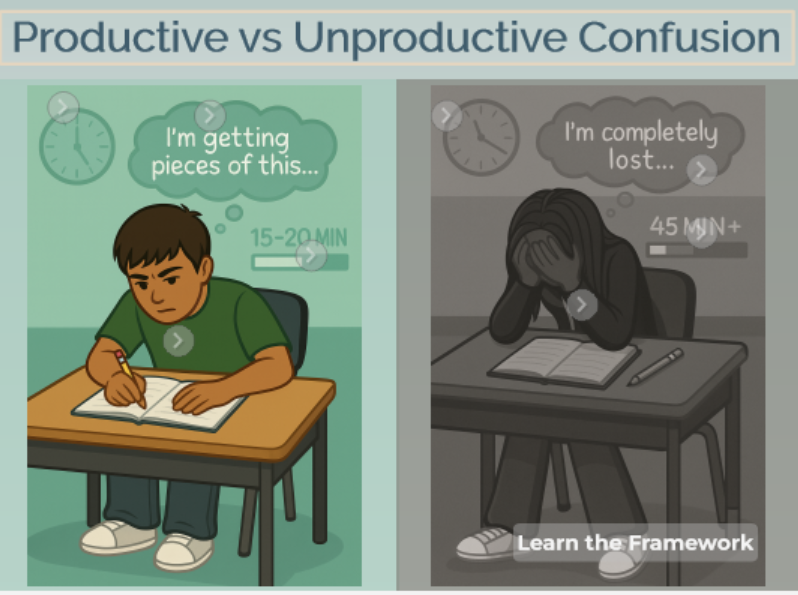
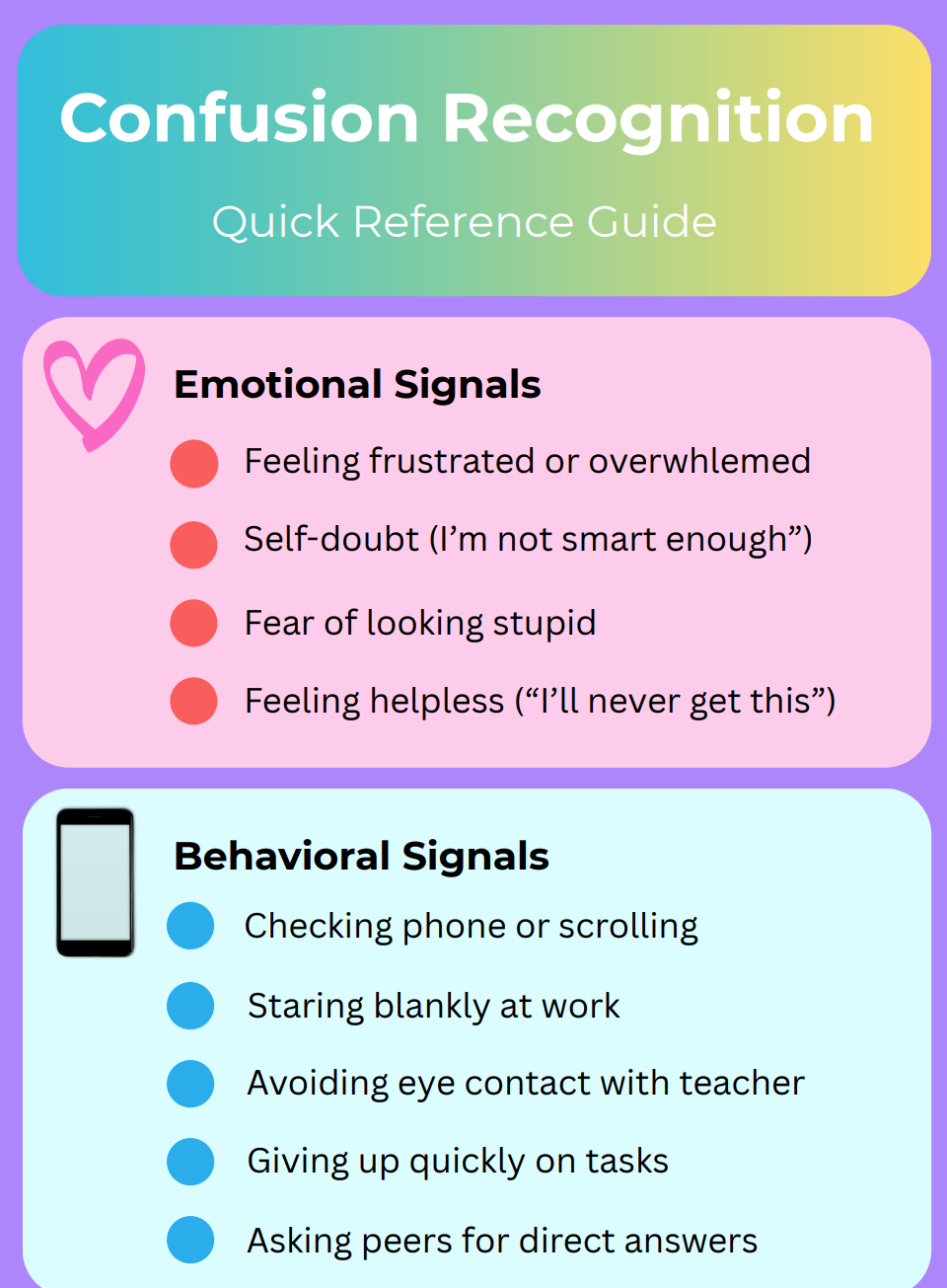
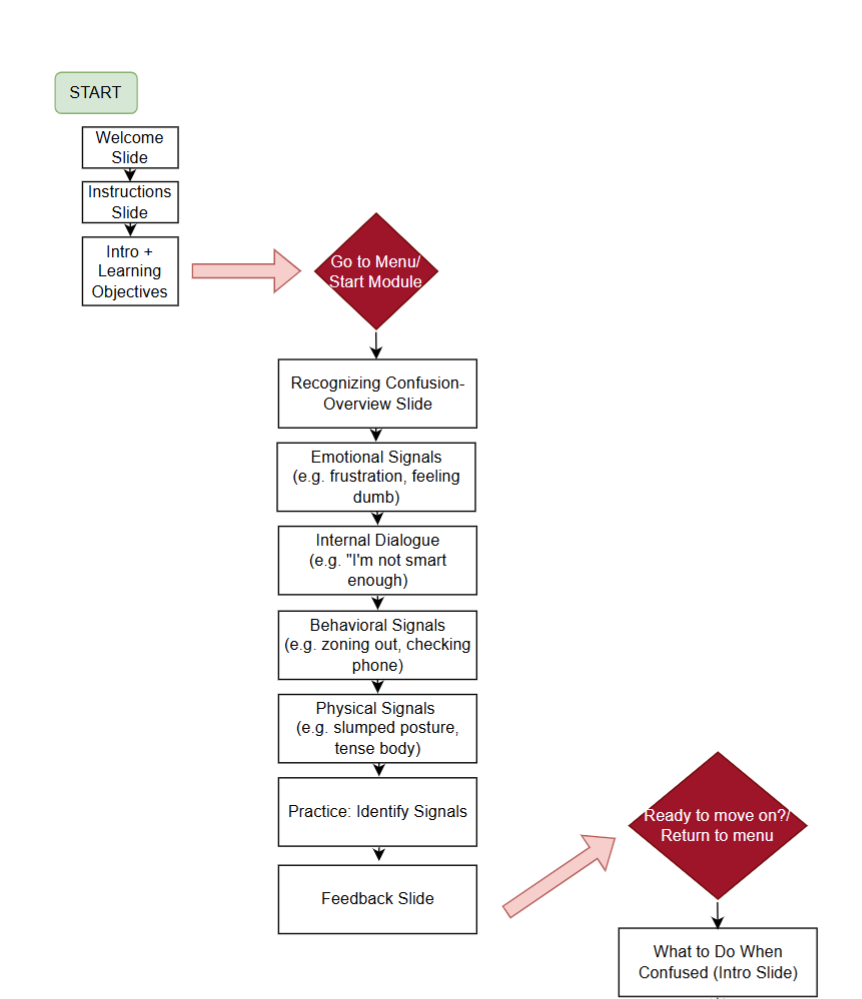


System Overview
The system treats confusion as a reliable data source. Instead of “try harder” feedback, learners get a small sequence of decision points: identify what type of confusion they’re in, choose the right support, and convert that support into an action they can repeat.
It combines instructional design structure with AI-assisted prototyping: the interface encourages explicit reasoning and reduces hidden cognitive load. The result is a learning pathway that makes progress legible to the learner.
Problem
Most learning friction is not a lack of effort. It’s a lack of clear next steps. When learners get stuck, they often receive vague guidance that doesn’t match their specific misunderstanding.
The outcome is a loop: confusion → hesitation → random trial → partial insight → confusion again. The learner’s cognition spends time guessing what support would help, instead of doing the work of understanding.
Approach
I designed the system around a single principle: supports must be conditional and actionable. Learners choose a support based on a quick diagnosis, then immediately apply it to a concrete task.
Each support is paired with a “conversion” step that translates insight into an executable move (a plan, a check, or a small reconstruction). That is where confusion becomes independent progress.
System Components
The system works because its supports are connected. Each component exists to reduce one specific kind of decision uncertainty.
Confusion Diagnosis
Connected Supports
Action Conversion
Reflection Loop
Build
The build phase focused on structure first: the UI and data model make diagnosis, support choice, and action conversion explicit. Instead of hiding complexity, the interface “stays honest” about decisions.
I used AI-assisted prototyping to explore variations in wording and flow, but kept the system’s logic deterministic. The AI helps with drafts and refinement; the learning system enforces the structure.
Reflection
The clearest outcome is that learners stop treating confusion as a personal failure. They learn to treat it as a navigational input.
The second outcome is operational: the system produces actionable artifacts (diagnosis notes, conversion steps, reflection records) that can be reviewed, improved, and reused.
Open to instructional design and learning systems roles.
I’m completing an M.S. in Learning Design & Technology and seeking opportunities in instructional design, student success, curriculum, and ed-tech. Reach out to connect.